

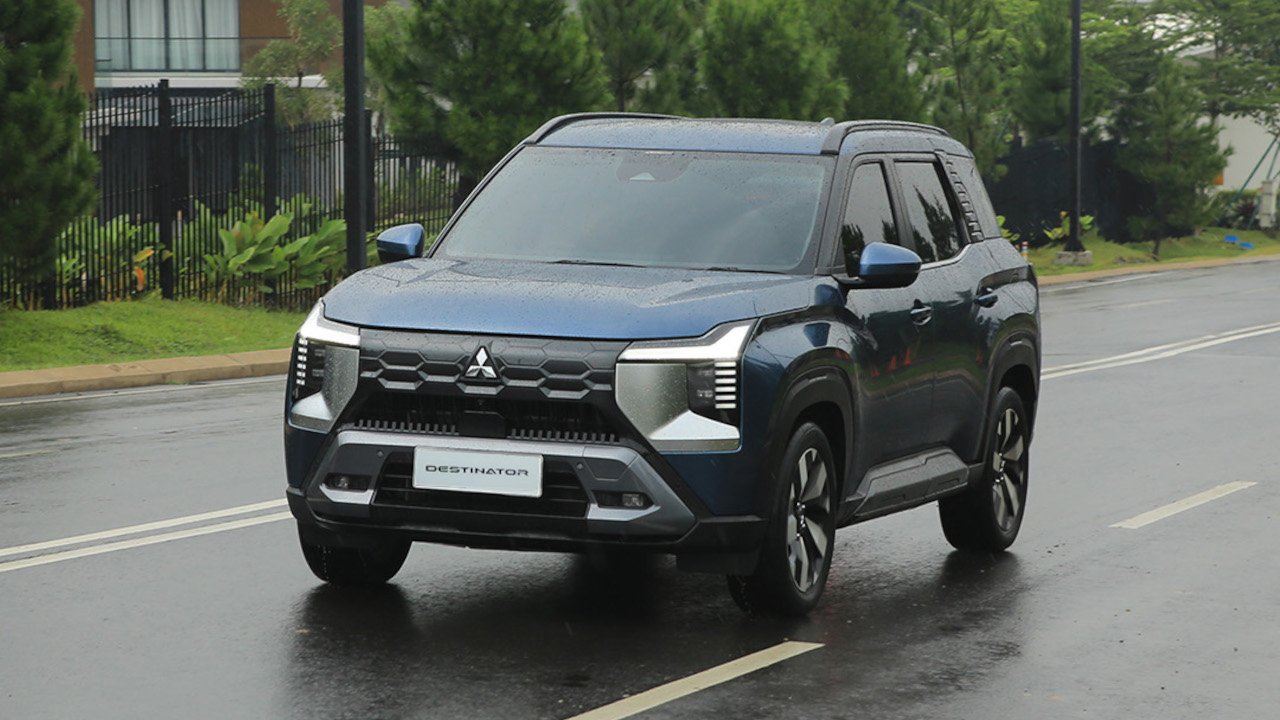
Jakarta – High ground clearance is one of the most useful characteristics of an SUV, particularly for drivers who regularly encounter uneven roads, steep ramps or flooded streets. But raising a vehicle’s body off the ground can also create concerns about handling, with many drivers assuming that a taller SUV will automatically feel less stable when cornering.
That assumption is not entirely accurate.
Vehicle stability is determined by a combination of factors rather than ground clearance alone. Engineers can use the vehicle’s center of gravity, wheelbase, track width, suspension geometry, body rigidity and electronic stability systems to control body movement and maintain predictable handling.
The Mitsubishi All-New Destinator is one example of how those elements can be combined in a relatively high-riding SUV. With a claimed ground clearance of 244 mm, the model is designed to provide additional clearance without simply accepting excessive body roll as a consequence.
Ground Clearance and Center of Gravity Are Not the Same Thing
One of the most important distinctions when discussing SUV stability is the difference between ground clearance and center of gravity.
Ground clearance refers to the distance between the lowest part of the vehicle and the road surface. Center of gravity, meanwhile, describes the point around which the vehicle’s mass is effectively concentrated.
A vehicle can have substantial ground clearance without having an excessively high center of gravity.
This gives engineers room to design an SUV that can clear obstacles and uneven surfaces while still keeping its mass distribution under control. The position of passengers, the engine, battery or other heavy components, and the overall body structure can all influence the vehicle’s center of gravity.
In the Destinator, the cabin uses a theater-seat arrangement, with the floor and seating positioned in a stepped configuration. The approach is part of the vehicle’s overall packaging strategy and contributes to how the cabin and vehicle mass are arranged.
The objective is not simply to make the vehicle taller, but to manage its overall proportions and weight distribution.
A Wider Stance Can Help Reduce Body Movement
The relationship between a vehicle’s height and its width is another important factor.
The Destinator uses a 2,670-mm wheelbase, while its wheel track is designed to provide a relatively wide stance. Wheelbase refers to the distance between the front and rear axles, while track width measures the distance between the left and right wheels on an axle.
These dimensions influence how a vehicle responds to steering inputs.
A wider track can help provide a broader base for the vehicle, while wheelbase affects characteristics such as directional stability and weight transfer. Neither dimension alone guarantees good handling, but together with suspension tuning they can help engineers achieve a more controlled response.
This becomes particularly relevant when an SUV enters a corner.
During cornering, the vehicle’s weight shifts toward the outside wheels. The suspension has to manage this transfer while keeping the tires in contact with the road and maintaining a predictable steering response.
Suspension Does More Than Absorb Bumps
Suspension is often associated primarily with ride comfort, but it also plays a major role in handling.
A suspension system has to perform several tasks at once. It needs to absorb road imperfections, maintain tire contact with the surface and control the movement of the vehicle’s body.
For the Destinator, Mitsubishi uses larger stabilizer bars and suspension components compared with some of its models with lower ground clearance. The suspension has also been specifically tuned for the vehicle.
A stabilizer bar, also known as an anti-roll bar, connects suspension components on opposite sides of an axle. When the vehicle rolls during cornering, the bar works to resist differences in suspension movement between the two sides.
This can help reduce excessive body roll without requiring the suspension to be excessively stiff.
The result is a balance between comfort and control. For a family-oriented SUV, that balance is particularly important because a setup that is too soft can produce excessive body movement, while an overly stiff setup can make everyday driving uncomfortable.
Body Rigidity Also Matters
Handling is not determined entirely by the suspension.
The vehicle’s body structure also affects how accurately the suspension can respond to driver inputs. A body that flexes excessively can make the vehicle’s behavior less predictable because some of the steering input is effectively absorbed by structural movement.
The Destinator uses Mitsubishi’s RISE, or Reinforced Impact Safety Evolution, body structure.
The structure is designed to combine rigidity with controlled weight. In addition to its role in crash protection, a rigid body can provide a more consistent platform for the suspension and steering systems to work from.
This can contribute to a more solid feeling behind the wheel, particularly when the vehicle is subjected to rapid changes in direction.
Electronic Systems Add Another Layer of Control
Mechanical engineering is only part of the equation in modern SUVs.
Electronic systems can also intervene when the vehicle detects conditions that could affect stability. The Destinator is equipped with systems including Traction Control and Active Yaw Control, along with selectable drive modes.
Traction Control can help limit excessive wheel spin when available grip is reduced. Active Yaw Control, meanwhile, can influence the vehicle’s behavior during cornering by managing the forces acting on the vehicle.
These systems do not eliminate the laws of physics. Instead, they provide an additional layer of assistance when the vehicle approaches the limits of available traction or when different wheels experience different levels of grip.
Drive modes can also alter the vehicle’s response depending on road conditions and driver requirements.
Why High Ground Clearance Doesn’t Automatically Mean More Body Roll
Body roll is ultimately the visible result of forces acting on a vehicle as it corners. A taller body can increase the leverage acting around the vehicle’s roll center, but that does not mean engineers have to accept uncontrolled movement.
The key is how the entire vehicle is engineered.
A relatively high SUV can use suspension geometry, stabilizer bars, track width, weight distribution and electronic controls to manage the forces generated during cornering.
This is why two SUVs with similar ground clearance can feel completely different from behind the wheel.
One may feel soft and prone to large body movements, while another may remain relatively composed. The difference comes from the overall engineering package rather than one specification printed on a brochure.
Ground Clearance Can Be an Advantage
For Indonesian driving conditions, high ground clearance can provide practical benefits.
Uneven roads, potholes, steep entrances, speed bumps and standing water are among the conditions that can make additional clearance useful. A vehicle with more space between its underbody and the road has greater room to negotiate these obstacles.
The challenge is making that capability compatible with predictable road manners.
The Mitsubishi Destinator’s 244-mm ground clearance shows why those two objectives do not necessarily have to conflict. Its center-of-gravity management, relatively wide stance, suspension tuning, stabilizer bars, rigid body structure and electronic stability systems all contribute to how the vehicle behaves on the road.
Ultimately, ground clearance is only one part of the equation.
A high-riding SUV does not have to feel unstable simply because it sits farther from the road. When the chassis, suspension, weight distribution and electronic controls are engineered as a complete system, an SUV can provide the clearance drivers want while still maintaining controlled body movement through corners.