

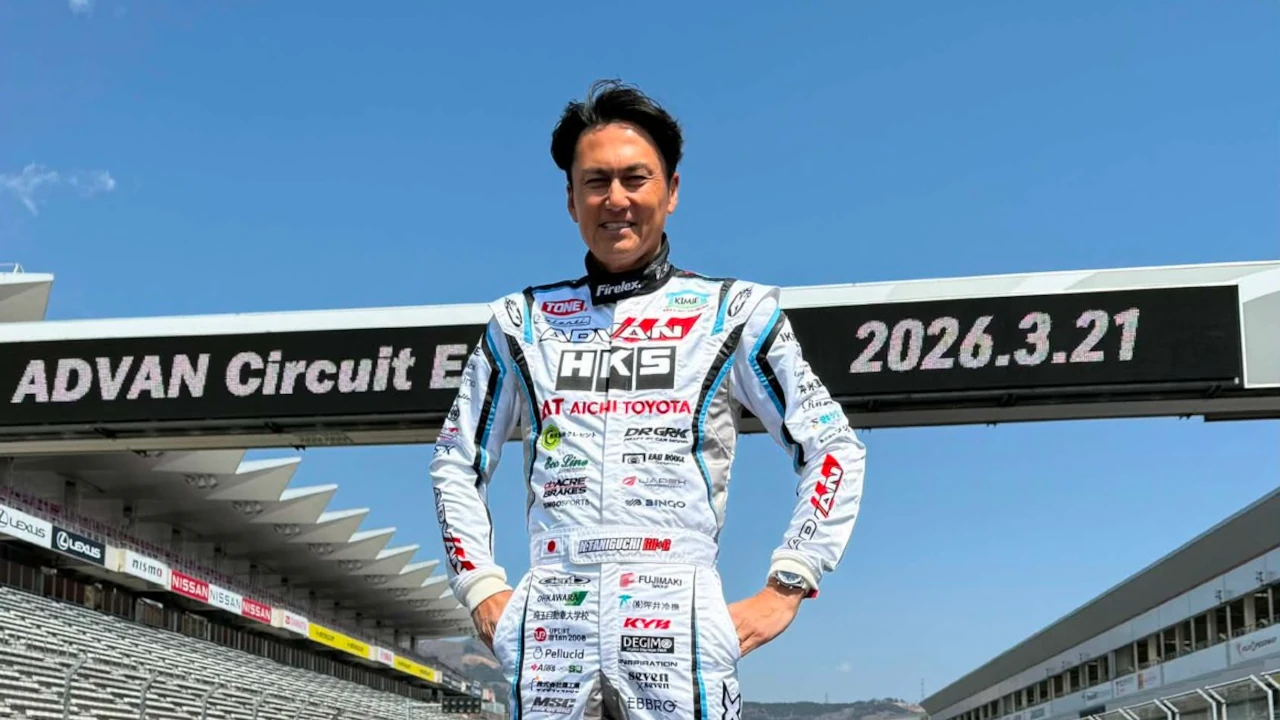
Jakarta – In Japan’s motorsport scene, few drivers have moved comfortably between drifting, circuit racing, endurance competition and time attack quite like Nobuteru Taniguchi.
Known to fans simply as “NOB,” a nickname associated with “No One Better,” the Hiroshima-born racer has built a career that stretches far beyond one discipline. From driving a Toyota AE86 on Japanese mountain roads to winning major international-level championships, Taniguchi has become one of the recognizable figures in Japanese automotive culture.
His career will also bring him to Indonesia, where he is scheduled to appear at the Indonesia Modification & Lifestyle Expo (IMX) 2026, themed “Next Gen Culture.” The event will take place from October 9 to 11 at Halls 1, 2 and 3 of ICE BSD.
His Racing Career Started on Two Wheels
Taniguchi’s path into motorsport did not initially begin with four wheels.
Born in Hiroshima on May 18, 1971, he started racing motorcycles and reportedly became a national mini-bike champion in Japan at just 18 years old.
His career changed direction after moving into four-wheel competition. He bought a Toyota AE86, a lightweight rear-wheel-drive car that became an important part of Japan’s tuning and drifting culture.
The AE86 introduced Taniguchi to street drifting on Japan’s mountain roads, commonly known as touge. That experience helped establish the driving skills that would later become part of his professional racing career.
His transition from street culture to organized motorsport eventually led him to professional circuit racing.
The D1GP Victory That Changed His Reputation
Taniguchi entered the Altezza One-Make Race in 2001, marking an important step toward professional circuit competition.
That same year, he made history by becoming the first overall champion of the newly established D1 Grand Prix.
He drove the now-famous Nissan Silvia S15 HKS, combining the car’s tuning potential with the driving techniques he had developed through years of drifting.
The D1GP title established Taniguchi as one of Japan’s leading drift competitors. But unlike drivers who remained focused on a single discipline, he continued moving between different forms of motorsport.
That versatility would eventually become one of the defining characteristics of his career.
From Drifting to SUPER GT
Taniguchi also achieved major success in circuit racing.
He became a three-time champion in the SUPER GT GT300 class, winning titles in 2011, 2014 and 2017 with GOODSMILE RACING.
The team’s distinctive Hatsune Miku-themed race cars became particularly recognizable among Japanese motorsport and anime fans. Taniguchi’s results in the category demonstrated that his abilities extended well beyond drifting.
He also competed extensively in endurance racing, including Super Taikyu events with PETRONAS SYNTIUM Team.
There, he drove high-performance machinery including the BMW Z4 and Mercedes-AMG GT3, adding another dimension to a career already spanning several disciplines.
Time Attack Became Another Specialty
If drifting established Taniguchi’s reputation, time attack helped demonstrate another side of his driving ability.
Time attack is fundamentally about setting the fastest possible lap rather than racing directly against another vehicle for position. Small improvements in setup, driving technique, aerodynamics, tyres and track conditions can therefore make a significant difference.
Taniguchi became closely associated with HKS and several of the Japanese tuner’s high-performance projects.
He repeatedly set impressive lap times at Tsukuba Circuit, including with the Mitsubishi Lancer Evolution CT230R and the HKS Racing Performer 86.
His work in time attack also reinforced his reputation as more than a professional racing driver. He became part of Japan’s wider tuning culture, where the driver, tuner and machine are often developed as one complete package.
A Familiar Face in Japanese Car Culture
Taniguchi’s influence also reached audiences outside traditional racing events.
He became a familiar face through Japanese automotive programs such as Best Motoring and Hot Version, where professional drivers and tuners tested high-performance cars on both road and track.
These programs helped introduce his driving style and personality to an international audience.
That combination of professional competition and automotive media made Taniguchi particularly influential among enthusiasts. He was not simply someone who drove race cars; he became a recognizable representative of Japan’s performance-car culture.
Bringing the Experience to Indonesia
Taniguchi’s appearance at IMX 2026 creates an opportunity for Indonesian enthusiasts to meet a driver whose career connects several generations of Japanese automotive culture.
According to IMX Project Director Andre Mulyadi, his participation also reflects the event’s relationship with Japan’s automotive industry and modification scene.
Andre said Taniguchi’s presence could provide Indonesian builders and enthusiasts with an opportunity to learn directly from his experience. The organizers have also indicated that the Japanese racer is preparing a special project for visitors at this year’s event.
For Indonesia’s growing modification community, that could make his appearance more than a celebrity visit.
Taniguchi represents a philosophy of automotive culture in which driving skill, engineering, competition and vehicle customization are closely connected. His journey from an AE86 on the touge to D1GP, SUPER GT, endurance racing and time attack shows just how broad that culture can become.
And that may be the most interesting part of Nobuteru Taniguchi’s legacy: he never allowed himself to be defined by just one type of racing.