

Singaraja – When people hear the word “rally,” speed is often the first thing that comes to mind. But time rally is a different kind of motorsport, where precision, navigation and the ability to manage time can be just as important as how quickly a car can move.
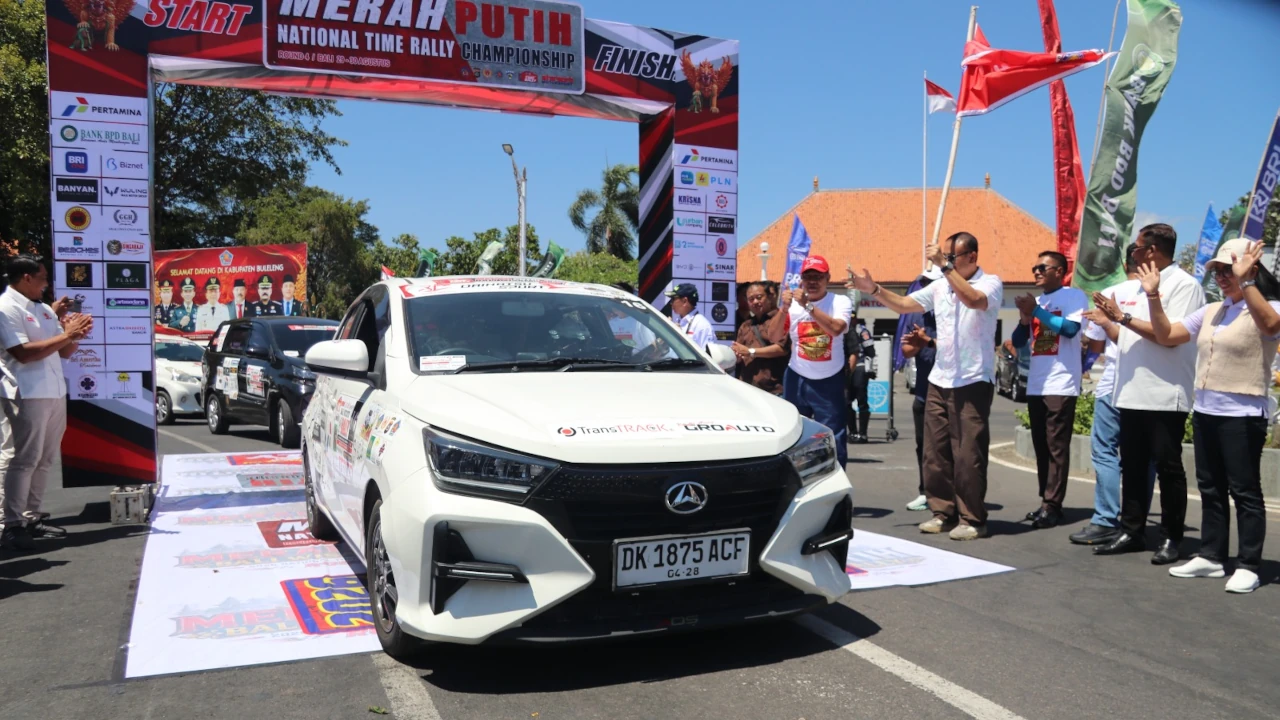
That became clear during the final round of the 2026 Indonesian National Time Rally Championship in Buleleng, Bali, where Astra Daihatsu Motor Marketing Director Rokky Irvandy made his first appearance in the discipline and immediately finished on top.
The Buleleng Paten Merah Putih Wisata Rally, held on August 29-30, covered approximately 250 kilometers over two stages. Rokky competed in the Seeded B category with fellow Daihatsu Sport Rally Team members Irfan Bahtiar and Kurniawan Rahardono, using a Daihatsu Ayla.
A Rally Where Being Fast Is Not Enough
Unlike conventional circuit racing, where the winner is generally determined by who crosses the finish line first, time rally places a much greater emphasis on timing.
Participants have to reach designated control points at specific times. Arriving too early or too late can result in penalty points, meaning a driver can lose a rally even without suffering a mechanical problem or making a major driving mistake.
The format was evident in Buleleng. Organizers explained that the routes were prepared in advance but only distributed to competitors after they started, making navigation and interpreting the instructions an important part of the competition.
That changes the role of the driver and crew.
Instead of simply pushing a car as hard as possible, the team has to constantly balance speed with accuracy while reading the route and managing the required timing.
Rokky’s First Experience Behind the Wheel
For Rokky, the Buleleng event was his first experience competing in a time rally.
His participation was partly intended to support Daihatsu Sport Rally Team, but it also gave the senior automotive executive an opportunity to experience the discipline directly.
Rokky said the rally allowed him to enjoy the journey while experiencing the roads and scenery of Bali. He also highlighted the suitability of the Daihatsu vehicle for the event, particularly across changing road conditions and undulating terrain.
The first stage did not immediately put his crew at the top of the standings.
Rokky, Irfan and Kurniawan finished the opening stage fourth with 47 penalty points. That put them within striking distance of the leaders while leaving the second stage to determine the final result.
Why Precision Can Beat Raw Speed
The challenge of time rally helps explain why experience in other forms of motorsport does not automatically guarantee victory.
A driver can have a fast car and strong driving skills, but excessive speed may actually become a disadvantage if it causes the crew to miss a timing requirement or make a navigation mistake.
The navigator and passenger also become crucial members of the team.
While the driver concentrates on controlling the vehicle, the crew has to interpret route instructions, monitor timing and communicate information quickly. The three-person combination therefore has to operate almost like a single unit.
This makes time rally as much a test of discipline as it is of driving ability.
A 250-Kilometre Test Through Bali
The Buleleng event covered roughly 250 kilometers across two stages, taking competitors through a variety of roads and landscapes in northern Bali.
The route was not simply designed to test the mechanical capability of the cars. Participants also had to deal with changing road conditions, navigation challenges and the requirement to arrive at control points according to the prescribed schedule.
For a first-time competitor such as Rokky, that combination created a very different experience from a conventional race track.
There are no permanent racing lines or familiar circuit corners repeated lap after lap. Instead, competitors have to process information continuously while adapting to the road ahead.
What Makes Time Rally Interesting?
Time rally occupies an unusual position within motorsport because it combines elements of competition, navigation and road driving.
The objective is not simply to drive faster than everyone else. The most successful crew is the one capable of completing the route while following the instructions and maintaining the required timing with the fewest penalties.
That also makes the discipline accessible in a different way.
The focus is not exclusively on highly modified race cars or extreme horsepower. Vehicle reliability, navigation equipment, crew coordination and the ability to remain disciplined can all make a difference.
Rokky’s debut in Buleleng illustrates that point.
Coming from the automotive industry rather than a full-time professional racing career, he entered a new form of competition and quickly adapted well enough to claim the top result.
A Different Way to Understand Motorsport
For spectators accustomed to MotoGP, circuit racing or traditional speed-based rallies, time rally can initially seem unusual.
But its appeal comes from the fact that winning requires more than a fast driver or powerful car.
It demands teamwork, concentration and consistency over an extended route.
That is perhaps the biggest lesson from Rokky Irvandy’s first time rally experience in Bali. In this discipline, the fastest driver is not necessarily the winner.
The winner is the crew that can make the fewest mistakes while staying precisely where it needs to be, exactly when it needs to be there.