

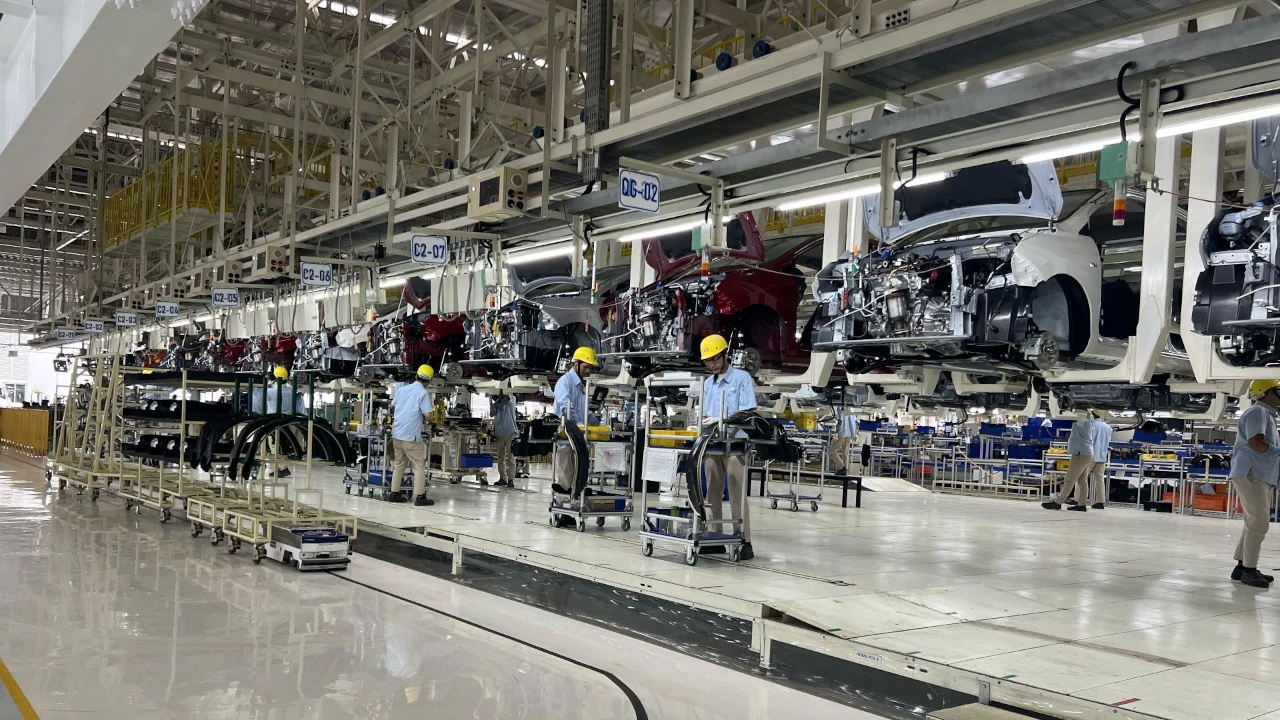
Jakarta – The automotive industry’s sustainability efforts are often associated with electric vehicles, battery technology and lower-emission transportation. But the environmental impact of the industry also depends on what happens before a vehicle reaches the road, including how efficiently it is manufactured.
Energy management inside automotive factories has therefore become an increasingly important part of the industry’s broader sustainability efforts. Production facilities operate a wide range of equipment throughout the manufacturing process, creating opportunities to reduce energy consumption through better technology, automation and process optimization.
PT Astra Daihatsu Motor (ADM) provides one example through its Smart Skid Cooling innovation, which recently received the 2026 National Energy Efficiency Award, or Penghargaan Efisiensi Energi Nasional (PEEN). The award was presented during the 12th Indonesia EBTKE Conex New Renewable Energy and Energy Conservation 2026 in Jakarta.
ADM was the only automotive manufacturer to receive an award in the Energy Management in Industry and Buildings category. Its Smart Skid Cooling program won the Special Innovation subcategory, competing against proposals from various sectors.
At the center of the innovation is a relatively specific challenge inside the vehicle production process: cooling the skid, or the fixture used to support vehicle frames during manufacturing.
According to ADM, the company developed Smart Skid Cooling independently by combining a cooling system, cyclone ventilation and automation. The system is designed to optimize the cooling process while adjusting energy use according to the actual requirements of production.
One of the clearest results is the reduction in skid temperature. ADM reported that the system can reduce the temperature from 102 degrees Celsius to 38 degrees Celsius.
The temperature reduction is important not only for the cooling process itself but also for the working environment around the production area. By reducing the heat generated in the area, the system can contribute to improved operational comfort while maintaining production stability.
The use of automation is another important part of the system. Rather than treating cooling as a process that operates independently of production requirements, Smart Skid Cooling is designed to align energy consumption with actual process needs.
That principle is relevant to energy efficiency across manufacturing industries. Equipment does not necessarily need to operate at maximum capacity continuously if production conditions change throughout the manufacturing cycle.
In a large automotive factory, even relatively small improvements in individual processes can become meaningful when repeated across long production periods. Cooling, ventilation, compressed air, lighting, heating and other industrial systems can all contribute to a facility’s overall energy demand.
This is why energy efficiency in automotive manufacturing is broader than simply replacing equipment with newer technology. It can also involve redesigning how existing processes work and using automation to make energy consumption more responsive to actual operating conditions.
The Smart Skid Cooling example also highlights the connection between production efficiency and workplace conditions. Reducing heat around manufacturing equipment can have implications beyond energy consumption, particularly when it helps create a more comfortable environment for employees working near the production process.
ADM’s recognition through PEEN 2026 places this type of factory-level innovation within the wider discussion around energy conservation in Indonesia. The government award is intended to recognize organizations that implement energy conservation and efficiency programs in a consistent, measurable and sustainable manner.
For the automotive industry, the issue is becoming increasingly relevant as manufacturers face pressure to reduce the environmental impact of their operations. The transition toward electrified vehicles may change what manufacturers produce, but it does not remove the need to make the manufacturing process itself more efficient.
This creates two parallel areas of sustainability for automakers. The first is the vehicle, including its powertrain, energy consumption and emissions during operation, while the second is the production system that consumes energy and resources before the vehicle reaches customers.
Manufacturing efficiency can also support broader corporate targets related to lower-carbon operations. ADM said its sustainability direction includes improving energy efficiency and increasing the use of renewable energy in its operations as part of its efforts toward lower-carbon manufacturing.
The Smart Skid Cooling system represents one example of how that approach can be implemented at the process level. Instead of relying only on large-scale changes, manufacturers can also identify specific stages of production where energy use, heat generation or equipment performance can be optimized.
As automotive factories become more automated and connected, opportunities for this type of optimization could expand. Data from production equipment can help manufacturers understand when energy is being consumed, how much is required and where adjustments can be made without compromising production quality.
The result is a broader definition of a sustainable automotive factory. It is not only a facility producing electric or fuel-efficient vehicles, but also one that continuously examines how energy and resources are used throughout the manufacturing process.
For Daihatsu, Smart Skid Cooling demonstrates how that principle can translate into a practical factory innovation. For the wider automotive industry, it offers another reminder that the road toward more sustainable mobility begins not only with the vehicle itself, but also inside the factory where it is built.