

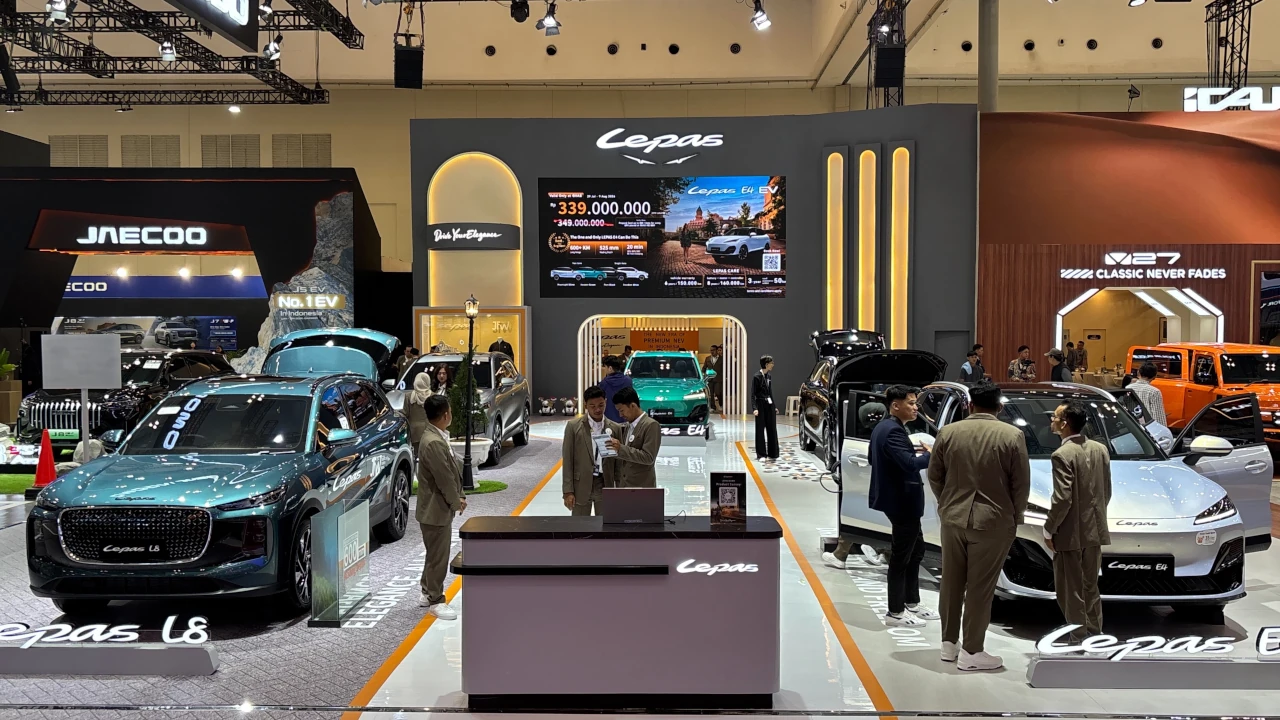
Jakarta – Chinese automotive brands are becoming an increasingly visible force in Indonesia’s car market in 2026. While Japanese manufacturers continue to dominate the overall sales rankings, several Chinese brands have recorded rapid growth and are beginning to occupy positions that were previously held by more established players.
The latest GAIKINDO data for January through August 2026 shows that Indonesia’s automotive market is growing, but the expansion is not being shared equally across all manufacturers. Total wholesales reached 599,491 units, up 20.1 percent from 499,315 units during the same period in 2025.
Retail sales also increased, reaching 594,984 units compared with 522,160 units a year earlier. The 13.9 percent growth indicates that demand in the domestic market has strengthened, while the performance of individual brands reveals a significant shift in the competitive landscape.
BYD Nearly Doubles Its Wholesales
Among Chinese manufacturers, BYD stands out as one of the strongest performers. Its wholesales increased from 18,989 units in January-August 2025 to 37,696 units during the same period in 2026, representing growth of 98.5 percent.
BYD’s retail performance was similarly strong. Retail sales reached 35,289 units, up 83.1 percent from 19,278 units in the previous year.
That performance puts BYD fifth in the wholesales ranking and fifth in retail sales for the first eight months of 2026. Its wholesales market share reached 6.3 percent, compared with 3.8 percent in the same period of 2025.
The numbers are particularly notable because BYD is competing in a market where Toyota, Daihatsu, Suzuki, and Mitsubishi Motors have long established sales and distribution networks.
The growth also reflects the increasing presence of electrified vehicles in Indonesia. However, the GAIKINDO data itself does not break down BYD’s figures by individual model or powertrain, so the overall sales figures should not be interpreted as a direct measure of EV demand alone.
Jaecoo Moves Into the Top 10
Jaecoo has recorded an even more dramatic increase in its sales volume, although from a much smaller starting base.
The brand recorded just 438 wholesales in January-August 2025. One year later, the figure had jumped to 23,834 units, representing growth of 5,341.6 percent.
Retail sales followed a similar trajectory. Jaecoo’s retail volume increased from only 290 units to 23,486 units, an increase of 7,998.6 percent.
The result places Jaecoo eighth in both the wholesales and retail rankings. Its August wholesales reached 3,300 units, slightly higher than the 3,200 units recorded in July.
This rapid rise is one of the clearest examples of how quickly a relatively new brand can gain volume in Indonesia when its products and market strategy find traction.
At the same time, the percentage growth needs to be viewed in context because the comparison starts from a very low base. Even so, reaching more than 23,000 units in both wholesale and retail sales in the first eight months represents a much more significant development than the percentage alone suggests.
Geely Also Gains Momentum
Geely is another Chinese brand showing a substantial change in its position.
Its January-August wholesales rose from 1,305 units in 2025 to 12,510 units in 2026, an increase of 858.6 percent. Retail sales reached 12,283 units, compared with only 1,224 units during the same period last year.
Geely therefore recorded more than 11,000 additional units in both wholesale and retail volume compared with the previous year.
The brand ranked 11th in wholesales and retail sales through August. Although its market share remains smaller than the leading Japanese manufacturers, its current volume is already higher than several brands that have been present in Indonesia for considerably longer.
This is an important distinction when looking at the development of Chinese automotive brands. Their impact cannot be measured only by whether they have reached the top three or top five positions.
The more significant change may be the number of Chinese manufacturers now capable of generating four- or even five-digit annual sales volumes.
Growth Is Not Limited to Three Brands
Other Chinese manufacturers are also showing growth, although at different rates.
Aion’s wholesales increased 30.7 percent to 5,034 units, while retail sales grew 10.9 percent to 4,621 units. Xpeng recorded 2,291 wholesales and 1,889 retail sales, compared with 247 and 178 units respectively in the same period last year.
Jetour also increased its volume significantly, recording 2,198 wholesales and 2,085 retail sales through August. Its wholesale figure was up 411.2 percent from 430 units in 2025.
GWM recorded 1,670 wholesales and 1,697 retail sales, with wholesale volume increasing 110.9 percent. Morris Garage also recorded growth, with wholesales up 150.2 percent to 3,075 units and retail sales up 120.7 percent to 2,823 units.
Not every Chinese brand, however, is moving in the same direction. Chery’s wholesales fell 39.7 percent to 7,867 units, while retail sales declined 36.9 percent to 8,209 units.
Denza also recorded lower volumes, with wholesales falling 54.2 percent to 3,001 units and retail sales declining 52.3 percent to 2,905 units.
The contrasting results suggest that simply being a Chinese brand is not enough to guarantee growth in Indonesia. Product positioning, model availability, distribution, pricing, and consumer response can produce very different outcomes.
Japanese Brands Still Lead the Market
Despite the rapid growth of several Chinese manufacturers, Japanese brands remain dominant in Indonesia.
Toyota recorded 175,931 wholesales in January-August 2026, giving it a 32.3 percent market share. Daihatsu followed with 100,884 units and a 17 percent share, while Suzuki recorded 47,908 units.
Mitsubishi Motors remained fourth with 43,753 wholesales, followed by BYD at 37,696 units.
The gap between the established leaders and most Chinese brands therefore remains substantial. However, BYD’s fifth-place position and Jaecoo’s eighth-place ranking show that the competitive picture is becoming more diverse.
Retail sales tell a similar story. Toyota remained first with 172,871 units, followed by Daihatsu at 97,059 and Suzuki at 48,554 units.
BYD’s 35,289 retail sales placed it fifth, while Jaecoo’s 23,486 units put it eighth.
A Changing Competitive Landscape
The data suggests that China’s automotive industry is no longer represented in Indonesia by only a handful of niche players.
Several Chinese brands are now generating meaningful sales volumes at the same time. Some are growing from relatively small bases, while BYD has already moved into the upper part of the national sales ranking.
The development is happening alongside broader growth in Indonesia’s automotive market. With total wholesales up 20.1 percent and retail sales up 13.9 percent through August, manufacturers are competing for a larger market while also fighting to capture a changing consumer base.
For established Japanese manufacturers, the challenge is not yet about losing overall market leadership. Toyota and Daihatsu continue to control a significant portion of the market, while Suzuki and Mitsubishi Motors also maintain strong positions.
The bigger change is that the number of credible competitors is increasing.
Chinese manufacturers are entering Indonesia with a wider range of products and, in several cases, rapidly increasing their sales volumes. BYD, Jaecoo, Geely, Aion, Xpeng, Jetour, and GWM now form part of a much more visible Chinese presence in the market.
Whether this momentum can be sustained will depend on how these brands perform beyond their initial growth phase. But based on the January-August 2026 GAIKINDO figures, one thing is already clear: Chinese car brands are no longer a peripheral part of Indonesia’s automotive market. They are becoming part of its competitive mainstream.