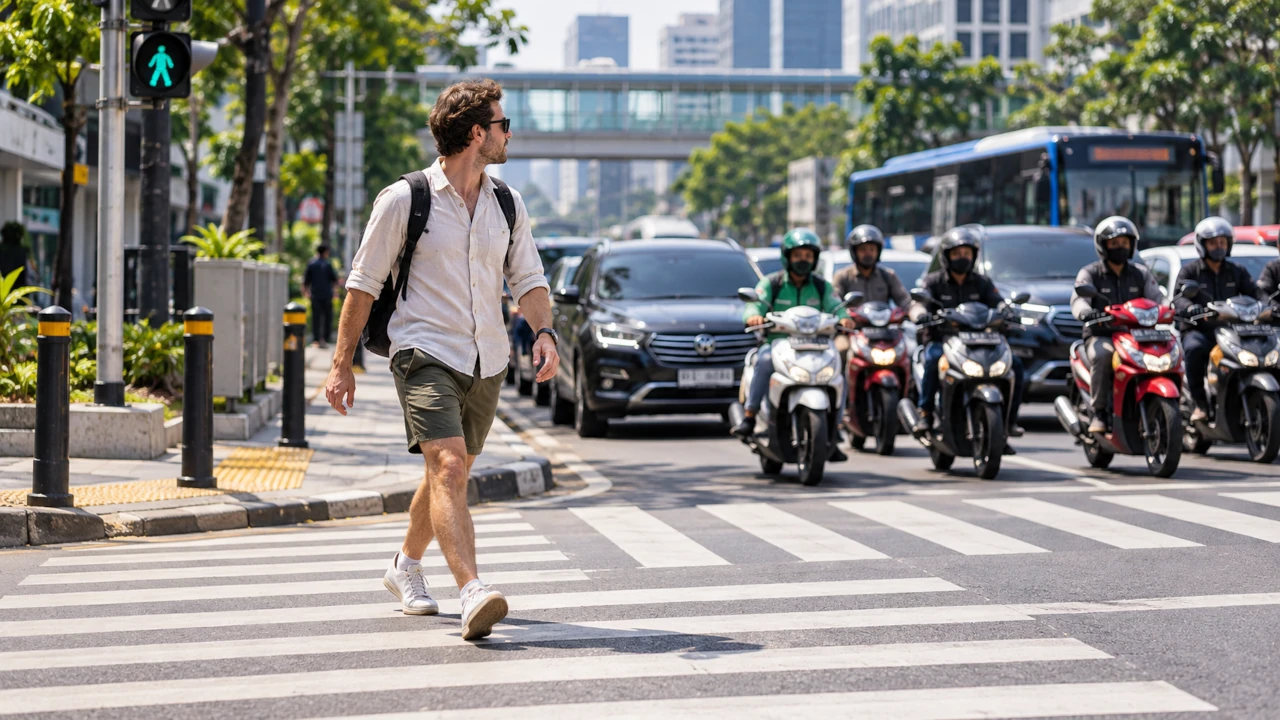
Jakarta – Walking in Indonesia can be a very different experience from walking in many other countries. Busy streets, motorcycles, cars, narrow sidewalks, informal parking, and changing traffic conditions can make even a short walk require more attention.
Indonesia has formal traffic rules that protect pedestrians. At the same time, foreign visitors may encounter everyday road habits that are not written in traffic laws but are useful to understand.
Knowing the difference between an official rule and an unwritten road habit can make walking around Indonesian cities easier and safer.
1. Use a Zebra Crossing When One Is Available
Indonesia’s traffic law gives pedestrians priority when crossing at designated crossing facilities. The law also requires pedestrians to cross at designated locations when those facilities are available.
For a foreign visitor, the simplest approach is to look for a zebra crossing, pedestrian crossing signal, or other designated crossing facility before crossing a busy road.
Do not assume that crossing a few meters away from a zebra crossing is equally safe simply because the road looks clear.
At some locations, however, a designated crossing may be difficult to find. In that situation, pedestrians still need to assess traffic conditions carefully.
2. Having Priority Does Not Mean You Should Walk Without Looking
Indonesian law requires drivers to prioritize pedestrian safety. This is particularly important at designated crossings.
In everyday traffic, however, a foreign pedestrian should not treat legal priority as a guarantee that every vehicle will stop immediately.
Look at approaching vehicles before stepping onto the road. Make sure the driver appears to have seen you and is slowing down.
This is especially important on roads with several lanes or where motorcycles are moving through traffic.
The practical rule is simple: having the right of way and staying alert should happen at the same time.
3. Do Not Assume Every Motorcycle Will Follow the Same Line
Motorcycles are a major part of traffic in many Indonesian cities. Their movement can feel different from what visitors are accustomed to in countries where motorcycles are less common.
A motorcycle may appear beside a car, move between lanes, or approach from a direction that a pedestrian did not expect.
When crossing, keep watching the traffic rather than looking only at the nearest car.
If one vehicle stops to let you cross, check the other lane before continuing. Another vehicle or motorcycle may still be approaching.
4. A Sidewalk Is for Walking, but It May Not Always Feel Like One
Indonesian law recognizes sidewalks as pedestrian facilities. Pedestrians have the right to facilities including sidewalks and crossing facilities.
In practice, sidewalks in some areas may also be affected by parking, street vendors, construction, utility infrastructure, or other activities.
Foreign pedestrians should therefore avoid assuming that a sidewalk will always provide a completely uninterrupted walking route.
If an obstruction forces you toward the road, slow down and check for approaching vehicles before moving around it.
The important distinction is that an obstacle on a sidewalk does not change the sidewalk’s basic function. It is still pedestrian space.
5. Watch for Vehicles Entering or Leaving Side Streets
A pedestrian may be walking safely along a sidewalk and still encounter a motorcycle or car entering or leaving a property.
This can happen at driveways, small alleys, parking areas, shops, restaurants, apartment buildings, and other entrances.
Pay particular attention when walking past an opening in a row of buildings.
A vehicle may cross the sidewalk before entering the road. Similarly, a driver leaving a property may need to cross the pedestrian path.
Do not assume that a vehicle emerging from a driveway has a completely clear view of the sidewalk.
6. Never Assume a Vehicle Stopped at a Zebra Crossing Means the Whole Road Is Clear
This is one of the most important practical habits for visitors.
A car stopping in one lane may give you space to cross, but another vehicle in a neighboring lane may continue moving.
Before stepping in front of a stopped vehicle, check the other lanes.
This is particularly important on wider urban roads. The first vehicle may have seen you while a motorcycle or another car farther away has not.
Cross one part of the road at a time and continue watching traffic.
7. Be Prepared for Cars and Motorcycles Near the Sidewalk
One of the less familiar experiences for some foreign visitors is encountering vehicles close to pedestrian areas.
A motorcycle may pass near a sidewalk entrance. A vehicle may cross the sidewalk to reach a parking area. A parked vehicle may partially obstruct the walking path.
These situations are not a reason for pedestrians to abandon caution.
If you need to move closer to the road because of an obstruction, check behind you and look for approaching traffic first.
Avoid suddenly stepping into the traffic lane.
8. Do Not Copy Unsafe Local Habits Just Because Others Do It
Foreign visitors may see people crossing roads outside designated crossings, walking along road edges, or moving through traffic in ways that appear routine.
A behavior being common does not necessarily mean that it is an official rule or a safe practice.
This distinction is particularly important when walking in an unfamiliar city.
Use local behavior as context, not as a substitute for traffic rules. If you see several people crossing in a particular place, still assess the traffic and available crossing facilities yourself.
9. Pedestrians Also Have Responsibilities
Pedestrian safety is not only the responsibility of drivers.
Indonesian traffic law requires pedestrians to use the part of the road intended for pedestrians or the road edge. Where a designated crossing exists, pedestrians are required to use the designated crossing. If no crossing facility exists, they must pay attention to traffic safety and flow.
That means pedestrians should also avoid suddenly entering traffic, walking carelessly into the road, or blocking traffic unnecessarily.
Visitors should also avoid using a phone in a way that prevents them from noticing vehicles around them.
Being a pedestrian does not mean being separated from the responsibilities of road safety.
10. Treat Indonesian Roads as Shared Spaces
Perhaps the most useful unwritten rule is to expect interaction between different road users.
A typical urban street can involve cars, motorcycles, buses, bicycles, pedestrians, delivery vehicles, street vendors, and people entering or leaving properties.
Not every movement will happen exactly as a foreign visitor expects.
That does not mean visitors should ignore the rules. Instead, it means they should combine knowledge of the formal rules with careful observation of what is happening around them.
Walk at a pace that allows you to stop. Look before crossing. Keep an eye on motorcycles. Give yourself extra time at busy intersections.
What Foreign Pedestrians Should Remember
The most important official principle is that Indonesian traffic law provides specific rights and protections for pedestrians. Pedestrians have rights to supporting facilities such as sidewalks and crossing facilities, and they receive priority when crossing at designated crossing locations.
At the same time, pedestrians have obligations. They should use designated facilities when available and pay attention to safety and traffic flow.
For foreign visitors, the safest approach is therefore not to rely exclusively on either written rules or local habits.
Use the official facilities whenever possible. Expect traffic to remain active around you. Check approaching vehicles even when you have priority. Be especially careful around motorcycles, driveways, intersections, and obstructed sidewalks.
Most importantly, remember that an Indonesian road can work differently from the streets you are familiar with at home.
Understanding both the formal rules and the everyday realities can make walking around Indonesia much easier. A little extra attention at a crossing or sidewalk can make the difference between simply getting to your destination and getting there safely.