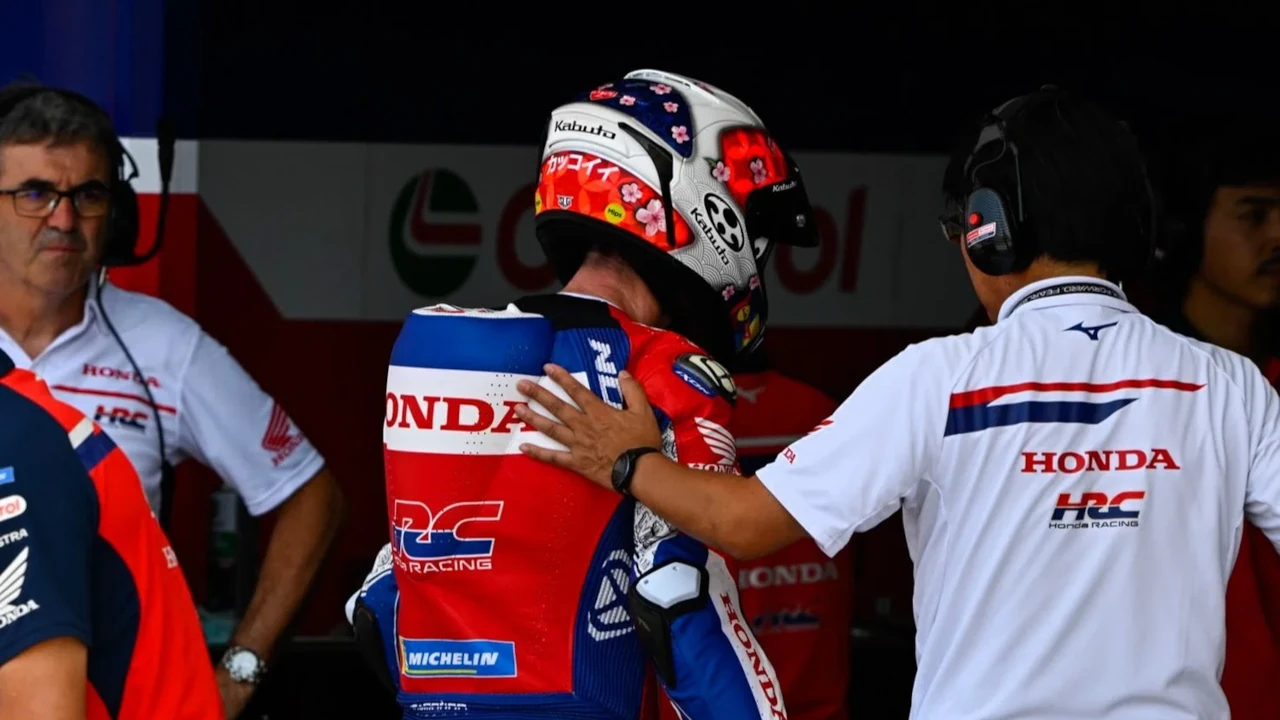
Mandalika – Aleix Espargaró’s MotoGP comeback was cut short at the 2026 Indonesian Grand Prix after physical difficulties prevented him from continuing at Pertamina Mandalika International Circuit. Honda and the Spanish rider agreed to withdraw from Sunday’s main race, prioritising his recovery after a serious injury earlier in the season.
Espargaró returned to MotoGP action in Indonesia as a replacement for Joan Mir. However, the weekend proved more demanding than expected, with the Honda test rider struggling to cope with the physical requirements of riding the RC213V.
His withdrawal brought an early end to a comeback that had already been complicated by limited preparation. Rather than risk aggravating his condition, the team opted to focus on his recovery and upcoming development responsibilities.
The decision also highlighted the physical demands of modern MotoGP machinery, particularly for riders returning from significant injuries without enough time to rebuild their strength and race fitness.
Physical Difficulties Become Clear During the Sprint
Espargaró’s struggles became apparent during Saturday’s Sprint Race. The Spaniard described a lack of strength in his arm and found it difficult to manage the motorcycle over the race distance.
A MotoGP sprint demands sustained physical effort despite being considerably shorter than a full Grand Prix. Riders must repeatedly brake hard, change direction, accelerate out of corners and control the motorcycle while managing tyre grip.
These demands can become particularly difficult when a rider has not fully recovered from an injury. Even a small loss of strength or mobility can affect control, consistency and confidence on the bike.
For Espargaró, the Mandalika weekend exposed the gap between being able to return to the track and being physically ready to compete at the highest level.
Honda’s decision to withdraw him from the main race reflected the importance of assessing a rider’s condition rather than continuing at all costs. Completing a race is not the only consideration when an athlete is returning from a serious injury.
A Serious Injury Limited His Preparation
Espargaró’s return followed a serious training accident earlier in 2026 that left him with four fractures in his back. The injury disrupted his preparation and limited the time available to regain his physical condition before returning to MotoGP.
A back injury can complicate a rider’s recovery because controlling a racing motorcycle places substantial demands on the torso, shoulders and arms. Riders must maintain their position under heavy braking while absorbing forces through rapid direction changes and acceleration.
The recovery process therefore involves more than simply waiting for fractures to heal. Riders also need to rebuild strength, endurance and the ability to withstand race conditions.
Espargaró arrived at Mandalika with limited preparation compared with a fully fit rider who had completed the usual training and race programme. The weekend became a difficult test of his readiness.
Although returning to competition was an important step, his physical struggles demonstrated that recovery does not always follow a predictable timetable.
Honda Chooses Recovery Over Another Race
Following an assessment of his condition, Honda and Espargaró agreed that he would not continue in Sunday’s Indonesian Grand Prix.
The decision was a practical one. Continuing while struggling physically could have exposed the rider to further difficulties, while withdrawing gave him more time to recover before his next responsibilities.
For a manufacturer such as Honda, test riders play an important role in developing future motorcycles. Their feedback helps engineers evaluate chassis behaviour, engine characteristics, electronics and other areas of performance.
A rider who is not physically ready may be unable to provide consistent feedback or complete the demanding work required during a development test. Allowing Espargaró to recover could therefore benefit both the rider and Honda’s longer-term programme.
His withdrawal should not be interpreted as the end of his MotoGP involvement. Instead, it represents a decision to reassess priorities after a comeback proved more difficult than anticipated.
Focus Shifts to Honda’s 850cc MotoGP Project
Espargaró’s next priority is recovery and preparation for Honda’s future development programme, including work associated with the upcoming 850cc MotoGP prototype test in Sepang.
MotoGP is preparing for a major technical transition, with the championship scheduled to introduce 850cc engines in 2027 alongside broader changes to the technical regulations. Development work before that transition is important for manufacturers seeking to understand the new package and identify areas that require further improvement.
Test riders will be central to this process. Their ability to complete testing consistently and provide detailed technical feedback can influence the direction of a manufacturer’s development programme.
For Honda, Espargaró’s experience makes him a valuable part of that effort. Protecting his recovery now may help ensure he can contribute more effectively when he is ready to return to testing.
The Indonesian Grand Prix did not deliver the comeback Espargaró had hoped for. However, the decision to withdraw reflects a longer-term approach to his fitness and Honda’s development needs.
His experience at Mandalika serves as a reminder that returning to MotoGP after a serious injury requires more than determination. Physical readiness remains essential, and sometimes stepping away from a race is the most sensible decision for both rider and team.